

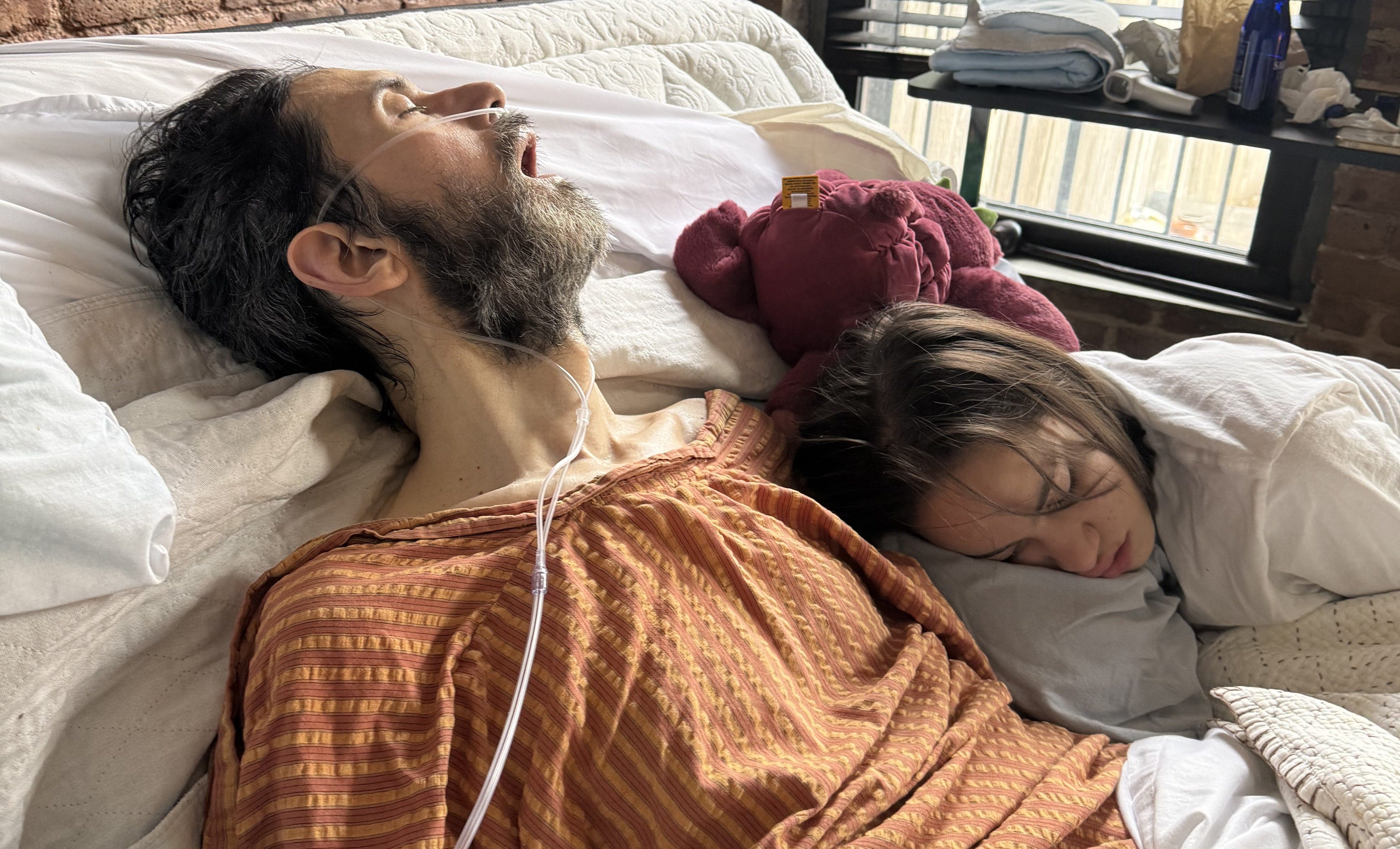
What follows is an annotated, extended version of my dad’s eulogy.
—
I started writing these remarks at 4:53 a.m. on the last night of my dad’s life. My mom was sleeping down the hall, and I was doing the nightshift; waking up every two hours (1:45, 3:45, and so on) to administer morphine. Not to be blunt, but I was prepared—fully prepared would be an exaggeration—to wake up next to his dead body.
When my mom (writer and clearer thinker than I) edited my eulogy, she told me to delete or amend that last line, to soften it, as people struggle with the bluntness of death even at a funeral. I ignored her advice. For years, I’ve engaged in a semi-automatic “editing down,” shielding my friends and family members from the full scope of my dad’s sickness, the full depths of my despair.
These past few months have required a large-scale “letting in”: the feelings I hold closest seeping into any and every casual conversation I’ve had. From my dad’s deathbed, I texted a friend in Invisible Ink, “I’m scared. He’s screaming.” At home, I spoke ad nauseam with my little brother, with whom I’d usually separate church and state (or church and dads). Despite my seeming proclivity toward oversharing, I’m uncomfortable with such real, overt suffering. He, Leo, does not need to see it.
Frankly, one of my favorite things about myself is my ability to switch modes; to sit with my dad in hospice from 9:00am-6:00pm, and to drink and dine with my friends from 7:00-9:00pm (though, perhaps, more like 7:00pm-4:15am with my current alcohol intake). My friends didn’t expect me to be okay, per sé, but I wanted to exceed their expectations, to hit it out of the park socioemotionally. For them, for me, for the sake of maintaining some form of regularity. On the days I couldn’t contain my anxieties, my sadness, I felt bad. No one signed up for two months of “bummer friend.” No one signed up to scrub my drunken vomit from three (!!!) separate hardwood and other surfaces.
You know when, in high school, those super skinny, lanky boys try to pick you up while making out because they think it’s the thing to do? (Promise it sounds strange, but it’s a rite of passage—my friends concur.) Now, I’m not calling myself fat by any measure, but then and now, I’m 100% sure that 16-year-old Owen couldn’t bear my full weight. That’s what this period felt like—tentatively, cautiously putting my shit onto others, knowing that they (exceptional as they are, but not superhuman or necessarily encoded for this) would rather bear a slightly lighter load.
It was my mom, my uncle, my dad’s best friend Sam Ahmed (the conglomeration I deemed, along with myself, the “core 4”) and a select (very select) group of my people who bore it all. Not to sound like a hippie freak, but it was through them that I saw—and kept a pulse on—the meaning of life.
—
Now, this sounds like a horrifying, Hadean premise for a sleepover, but when your dad has Dementia with Lewy Bodies for nine years, you learn to see and appreciate the silver linings, no matter how perverse they are. That night was the first night I’d spent in Red Hook, at 132 Dikeman Street, with him in years. I fell asleep watching Harry Potter and it felt, for a second, like I was nine-years-old and we were coming back from one of our weekly karaoke nights at Hope and Anchor. Maybe I had sung “Never Say Never” by Justin Bieber. Perhaps he had gone for “Maxwell’s Silver Hammer,” by the Beatles, of course. Point being, despite it being nothing like old times, it was just like old times. I liked being at our house and I liked being close to him.
Zack has told me on numerous occasions that I’m the “strongest person [he] knows.” But I’m not. Any one of us would be if they, like me, had a dad with a slowly destructive neurological disease. I don’t feel strong, or graceful. I feel like an older version of my nine-year-old self, who loves, almost idolizes, her father.
When I was younger, I’d text my mom these slightly manic, melodramatic texts about my dad’s snoring. I’d shove pillow after pillow under his door, trying but failing to quell the animalistic noise coming from his bedroom. I made him, a natural-born hypochondriac and unerring obsessive, feel terrible about his super normal affliction. He cycled through home remedies and mouthtape, searching for a cure.
My dad’s dementia symptoms first manifested as insomnia. No more snoring, no more sleep. Be careful what you wish for—it’s a platitude for a reason. That night (2/21/2026), we all felt an indescribable, somewhat illogical relief when my dad switched from agonal breathing to normal, run-of-the-mill snoring. Agonal breathing is a “critical, life-threatening sign of ineffective, gasping respiration—not true breathing—indicating severe brain oxygen deprivation.” It’s “characterized by sporadic snoring, snorting, or moaning sounds, often mistaken for breathing.”
We spent the majority of that afternoon waiting, with bated breaths, as he fell into repeated thirty second non-breathing spells; we clutched each other, a strange, thinly veiled euphoria surfacing as his uneven breaths returned. Another minute! Another hour! Another day! For the time being, we had evaded the inevitable.
In the hospital, David Bowie, The Smiths, Fleetwood Mac, Imogen Heap, and the Beatles cycled on repeat. “This song is so Daddy,” my mom said as “Silver Springs” played for the thirtieth time, not knowing that the whole world shares in our idée fixe. I played “Heaven” by Bryan Adams and Apple reminded me that it was maybe, superstitiously in bad taste. I played Radiohead’s “You and Whose Army?” which reminds me of Charlie (in a nice way), but sounds like a death march.
The song that got me, though, was “Tomorrow” from the Annie soundtrack. The sun will come out tomorrow—it wouldn’t. So you gotta hang on ‘til tomorrow—he might not. My lips quivered instinctually and I cried (sobbed) every time it played. I think it was also the prepubescent little girl’s voice—she sounded how I felt: young. Her cadence, her innocence, were incompatible with the brutality of the moment. Everyday, before I left my dad’s side, I’d prop up my phone and unleash the hopeful croonings of Aileen Quinn (Annie). I have crippling OCD and I wanted him to have a tomorrow.
—
There is so much to be said about my dad, and so much I want to hear and know from all of you—about who he was in high school, in law school, or at work. About what he was like at my age (22), or later in adulthood, before he got sick. The thing about being a kid is you never ask your parents enough questions. You’re their world, they orbit you, and that’s just how it is. By the time I wanted to, by the time I was a sentient, semi-adult human being and the impulse kicked in, my dad had already been diagnosed. Frankly, His world, as I knew it, was me.
What got/broke me, other than specific musical interludes, was comments from his best friends and ex-girlfriends saying, “He loved you so much. You were his whole world.” Would his world deliberately miss or ignore ten calls in a row? Would his world cancel plans, using his newfound forgetfulness against him? Would his world leave him twice, moving across oceans at critical times in his illness? What a lame, underwhelming world I was. He deserved better; he deserved the full expansiveness of existence. He deserved more than fifty-eight years to use and hone that extraordinary brain of his. More than one twenty-two-year-old daughter who, not infrequently, sleeps until the early hours of Sunday afternoon—too hungover and attenuated to Tito’s fricking Vodka to visit her ailing father.
—
Like other fathers and daughters, we watched Moneyball together. If you haven’t seen it, Brad Pitt’s character basically rebuilds a low-budget baseball team and, shortly after, gets an offer to manage one of the best teams in the league. He’s about to move across the country when he plays a pre-recorded song from his daughter. It goes:
“I’m just a little bit caught in the middle,
Life is a maze and love is a riddle,
I don’t know where to go,
Can’t do it alone,
I’ve tried… and I don’t know why.”
It’s cuter—and perhaps more emotionally stirring—when she sings it, but frankly, it’s kind of my (or our) song.
Thus far, my dad’s sickness has obviously been the big tragedy of my life. But it’s also showed me the ways human relationships can metamorphose and belie easy categorization. While I’ve been at school, my mom—my dad’s ex-wife—has largely borne the brunt of his care. I am, and will always be, incredibly proud of the two of them; of how they emerged from a complicated marriage and became, in the truest sense of this designation, best friends. He was, to her, part brother, part child, part history… the person who had witnessed every version of her life.
At the funeral, my uncle said something to the effect of “Chernoffs never get divorced.” I am a Chernoff, so by the hereditary factor, that is true for me too. In a literal sense, I hope my future marriage works out the first time around. More figuratively, though, I never want to get divorced either. Since the genesis of my dad’s symptoms, I’ve felt very strongly that loss (uncontrollable loss) is the worst thing in the world.
My uncle’s ex-wife was at my dad’s burial, standing beside his current wife and child, altogether a motley tableau. In theory, and perhaps to their dismay, I’d want my exes there too. I feel, unreservedly, that once you enter my life—really enter my life—you’re there to stay, for better or for worse. Most people push back against the “for worse”: it’s not healthy to be friends with exes, it’s not feasible. But whose shitty code of commandments is that? “No,” I’ll tell them from now on. “The Chernoff bylaws espouse a no-divorce philosophy.” Don’t leave me, reads the legislative subtext. Don’t leave me like he did, says the even smaller lettering.
—
He was, to me, something equally elusive—and, in the near-impossible task of writing your dad’s eulogy, even harder to define. My dad was austere, orderly, impassive, and judicious. I am none of those things.
And yet, it’s hard for me to tell where he ends and I begin; whether my tendency toward frugality, or my urge to try the small Bengali restaurant, swarmed by taxi drivers on West Broadway is mine or his. Whether I actually cared about the Gambino mafia’s social club on 3rd Avenue and Carroll Street, or whether he just reminded me of it, that fact—and many others—almost everyday of my existence. Whether I’m stubborn, or whether he was just stubborn and it takes two to tango, especially when one of them is a federal prosecutor who raises his daughter like life is a deposition.
I am my father’s daughter. That’s all. My mom tells me she doesn’t see it—that I’m my own person. I’m not. I’m so him that I practically want to stick a feeding tube up my nose and start convulsing, reacting to a missing dose of Seroquel I do not, myself, need.
—
It’s also hard to tell when he stopped being the parent, and I, the child. Was it when I learned to navigate the metro system in his favorite city, New Delhi, because he was cognitively unable to read a map? Or was it when I threw him a karaoke birthday party with just my friends and Sam, and ordered drinks for the table with my fake ID—something he would never in a million years condone?
This, here, is why I’m “strong.” It has got to do something strange and Freudian to you when you’ve been buckling your dad’s pants since your teenage years, and have been privy to a naked version of him by twenty-two. What a sight to behold—your formerly 215-pound, 6’4” father lying, immodest and incontinent, on a hospital bed. Until the end neared, we had maintained a sense of privacy. It was tenuous, almost non-existent in his most fragile moments, but my dad never wanted me to see that. He never wanted me to see any of it, as indicated by the bright orange bracelet on his right wrist: Do Not Resuscitate. Do Not, I thought to myself, in any case, Resuscitate.
There came a time, a particularly freaky Thursday morning, when the doctors asked for my opinion. Tons of terms and phrases were thrown around: palliative care, feeding tube, choice, hematoma, brain bleed, choice?, ten minutes of consciousness a day. I do not wish to write about this part, so all I’ll say is: there wasn’t really a choice, only the illusion of one. I was grateful/appreciative that they deferred to me (my mom was, by title, his healthcare proxy), but I resented the implication that any real agency was involved.
My pre-med ex-girlfriend spoke plainly to me (how’s that for non-divorce?), and my therapist offered to speak with any doctor necessary and translate their medical jargon, but that was beside the point. I didn’t choose any of this. No one should put a twenty-two-year-old girl in charge of anything, least of all matters of life or death (her father’s).
When I told my friends, it was hard not to keep score. Languishing in the uncertainty of “palliative care,” some didn’t grasp how acute things were or how short the timeline was. It was partially my fault; I didn’t want them to panic. But soon, it would become obvious that panicking alone was not an option. “We can talk about other things, too,” I reassured multiple groupchats. But when we did—tiny work hiccups, Valentine’s Day dinner plans—I wondered why their lives, like mine, did not revolve solely around this.
I craved normalcy, but I resented it too. Why on earth would I want to get drinks with your middle school friends right now? How on earth could you know that I’d wince at the offer? Like I said, I tried to compartmentalize—for them and for me. But I wanted recognition for the enormous amount of emotional fortitude it took to do so. Peanut butter cookies, care packages, bags of frozen pasta, and bouquets of white and violet flowers trickled in (rushed in, really). I loved my friends; I felt sorry for my unevenly distributed resentment. I wanted more reaffirming texts; I wanted less attention. What I really wanted was my dearly beloved father—I wanted him back.
—
A lot of it is confusing and hard to sort through, but what I do know is: my dad was the most singular and special person I have ever known. Nothing is—or will ever be—as blissful and intoxicating as his full, undiluted affection. No one will ever be as unerringly smart, or as startlingly funny. No one can be as important, as beloved. And no one will ever know or understand the shared world that existed only between us.
Mia asked me if I knew the funeral was going to be “all about me.” I did. My dad was unmarried, without other kids, despite the fact that, rhetorically, he left his money to “all of his children.” My relationship with him existed in a vacuum. No whole family dinners, just the two of us—in Thailand, in India, in Florida, in Paris, in Los Angeles, and at home. We played chess and recorded longform interviews with fake British accents. We played soccer and ate pupusas in the grass fields of Red Hook. My mom is obsessed with me, sure, but my dad’s obsession was different. His best friend Eli invoked the phrase, “Violet colored glasses.” My dad wore them for 22 years straight.
Those last few days, people filed in. There was something surreal about seeing the stoic, manly-man lawyers I’d known since babyhood cry. Some cried openly, professing love, showing grief with a boyish unsteadiness. Some cried quietly, turning tear-streaked faces away from me as they said their goodbyes. I have a million thoughts (too many) about those moments. I have a couple more (fewer) about the tear-streaked faces of my guy friends. Male friendship is beautiful, and so, too, is male vulnerability. Never have I, a girl, been so privy to any of it.
Right now, I’m reading Between Two Kingdoms by Suleika Jaouad—a memoir and journalistic masterpiece about leukemia. She coins the term “disaster tourists,” referring to people who, when she got sick, came out of the woodwork: “those I didn’t know well who showed up unannounced at my hospital room door with an overzealous desire to help, or to bear witness to the medical carnival my life had become. They would gape at my bald head, misty-eyed, and I’d find myself consoling them.”
Picture the metaphorical fanny packs, the disingenuous utterances of solemnity borne from a relatively foreign place. My dad’s decaying body, my own—wrapped around his, unmoving—were the big spectacle. “Do you see the bright red contents of his urinary catheter?” I felt like saying. “That’s what happens when you’ve forgone food for two weeks and your kidneys fail!!!” Do you guys absolutely love it when I cry? I goaded non-verbally, eyeing them into discomfort. You’re not welcome here. Thank god for the Core 4, the on-site tour guides of the place. Sam Ahmed was as local as they come.
It goes without saying, but I had no patience, nor energy, to entertain the guilt-ridden friends whose names I hardly recognized. The friends who stopped calling when he started struggling with his phone and butt-dialing in perpetuity. The friends who stopped coming because Red Hook was far and work was busy. The friends who panicked, understandably but inexcusably so. For literally god knows what reason, they felt they should re-emerge at his deathbed. Show’s almost over, guys! Thanks for coming, not.
—
I could, in Roiphe family fashion, end with an arcane, over-the-top literary reference. I could say that when Freud’s father died, he wrote to a friend, “I feel now as if I had been torn up by the roots.” But I am, in fact, a Chernoff, so instead, I want to call your attention to the program and a less esoteric quote that my father loved.
The only poem he’s ever sent me, or maybe ever read, ends with: “You did, you loved, your feet are sore. It’s dusk. Your daughter’s tall.” Well dad, it’s true: I’m 5’8 and a half now, and I hope I am some of the best, most inimitable parts of you. Apparently, when someone is in hospice, you’re supposed to tell them that ‘it’s okay to go.’ As my brother, Leo, and I said that day—and as it kind of has to be now:
“Dad, it’s okay for you to go. And we’ll take it from here.”
Everyone says grief comes in waves, but I didn’t realize just how tempestuous they’d be. Today, a month after his death, I don’t feel good at all. None of the important stuff feels important; school, 401(k)s, jobs, norms, ambition. It’s hard to imagine when, if ever, it will all feel soooo important (crushingly so) again. I’m more focused on the “you did, you loved, your feet are sore” part. Per the Beatles, all you need is love. Dead serious—no pun intended!—that’s all I really need now and hereafter.
In his book On Love, Alain de Botton writes: “Love reinvents our needs with unique speed.” Well, so does loss. Everything is different now. Everything will be different forever.
Thanks for sharing, Violet, I was too shy/trying to be too polite(?) to ask for a copy. I appreciate so much what you said at the memorial and deeply appreciate your love for your father.
Amazing Vi ❤️ Will always be in awe of you and how you put the most eloquent words to the most difficult feelings